
Frequently Asked Questions
As a hearing aid manufacturer in China, Jiajianle provides OEM and ODM solutions for distributors, hearing centers, pharmacies, e-commerce importers and private-label brands. Find answers about our factory, products, certifications, customization, orders and cooperation.
- All
- Factory & OEM/ODM
- Hearing Aid Guide
- Maintenance
- Product Selection
- Purchase & After-sales
- Troubleshooting
Yes. Depending on the product and destination market, we can provide applicable certificates, test reports, product specifications, MSDS and other supporting documents available for the project.
Jiajianle maintains an ISO 13485-certified quality management system. Our establishment and applicable hearing-aid products are registered/listed with the U.S. FDA. We can also provide applicable product certificates, test reports and regulatory documents according to the destination market and project requirements.
Yes. We welcome qualified distributors, importers and business partners to visit our factory in Guangzhou, China. Factory visits can provide a closer look at our production, assembly and quality inspection processes.
Yes. We support customization of product logos, colors, packaging and user manuals. Customization options and MOQs depend on the specific product and project requirements.
We manufacture BTE, ITE, pocket and neckband hearing aids, including digital, analog and rechargeable models. Different models are available for different product requirements and market needs.
Yes. We provide OEM and ODM services for distributors, hearing centers, pharmacies, e-commerce importers and private-label brands. Our services include product, logo, packaging and user manual customization according to project requirements.
Guangdong Jiajianle Technology Co., Ltd. is a hearing aid manufacturer based in Guangzhou, China. We operate our own production, assembly and quality inspection processes and work directly with customers on OEM and ODM projects.
Choosing the right hearing aid style is one of the most important decisions for users and distributors. Two of the most common types are BTE (Behind-the-Ear) and ITE (In-the-Ear) hearing aids.
Each style has advantages depending on hearing loss level, comfort preference, and budget.
This guide explains the differences to help you choose the most suitable hearing aid.
What is a BTE Hearing Aid?
BTE (Behind-the-Ear) hearing aids are worn behind the ear and connected to an ear tip or ear mold through a sound tube.
Advantages of BTE hearing aids:
- Strong amplification power
- Suitable for mild to severe hearing loss
- Easy to operate
- Comfortable for long-term use
- Larger battery capacity
- More durable structure
BTE hearing aids are one of the most popular styles worldwide due to their reliability and performance.
What is an ITE Hearing Aid?
ITE (In-the-Ear) hearing aids are placed inside the outer ear.
Advantages of ITE hearing aids:
- Smaller size
- More discreet appearance
- Convenient to carry
- Suitable for mild to moderate hearing loss
However, ITE hearing aids may have limited power compared with BTE models.
Key Differences Between BTE and ITE Hearing Aids
| Feature | BTE Hearing Aid | ITE Hearing Aid |
|---|---|---|
| Wearing position | Behind the ear | Inside the ear |
| Power level | Higher | Medium |
| Suitable hearing loss | Mild to severe | Mild to moderate |
| Battery size | Larger | Smaller |
| Ease of use | Easier | Smaller controls |
| Durability | More durable | More delicate |
| Price range | Cost-effective | Usually higher |
Which Hearing Aid is Better?
The answer depends on user needs.
Choose BTE hearing aids if:
- Moderate to severe hearing loss
- Need stronger sound amplification
- Prefer easy operation
- Want cost-effective solution
- Suitable for elderly users
- Suitable for online sales markets
Choose ITE hearing aids if:
- Mild hearing loss
- Prefer smaller size
- Care about discreet appearance
For most users and distributors, BTE hearing aids provide a better balance between performance, price, and usability.
Recommended BTE Hearing Aid Models
As a professional manufacturer, we provide several rechargeable BTE hearing aids designed for global markets.
Below are popular models suitable for different market needs.
Entry-Level High Gain Model
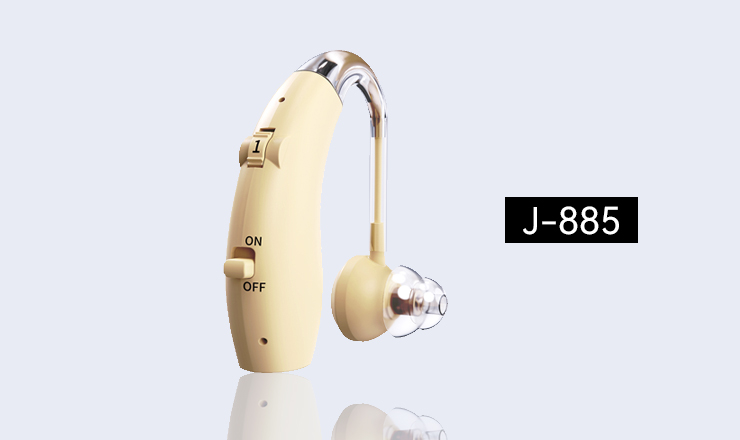
J-885 Rechargeable BTE Hearing Aid
Suitable for:
- Mild to moderate hearing loss
- First-time users
- E-commerce best sellers
- Cost-sensitive markets
Key features:
- High gain sound output
- USB rechargeable battery
- Easy operation
- Comfortable wearing design
- Suitable for long daily use
Suggested product:
Classic Cost-Effective Model
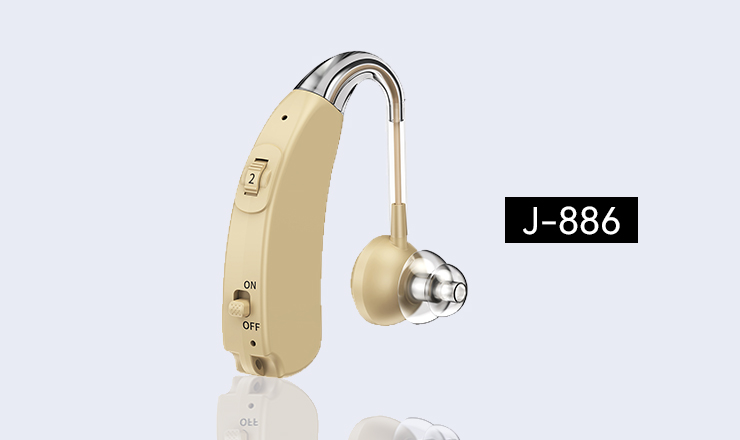
J-886 Rechargeable BTE Hearing Aid
Suitable for:
- Moderate hearing loss
- Stable long-term sales
- Distributors and wholesalers
- Online platforms
Key advantages:
- Reliable performance
- Competitive pricing
- Simple user interface
- Popular in volume markets
Suggested product:
Mid-Range Digital Model
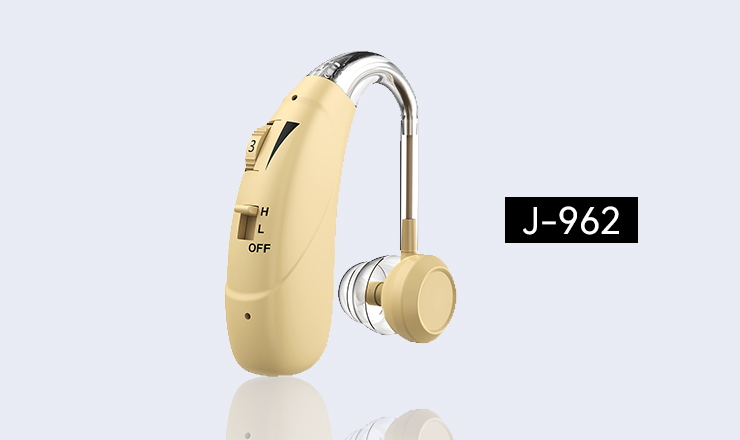
J-962 Digital Rechargeable BTE Hearing Aid
Suitable for:
- Users needing clearer sound
- Mid-range product positioning
- Customers seeking better sound performance
Key features:
- Digital sound processing
- Rechargeable battery
- Stable amplification
- Comfortable wearing experience
Suggested product:
Why BTE Hearing Aids Are Popular Worldwide
BTE hearing aids are widely used because they:
- Provide stable sound amplification
- Fit different ear shapes
- Are easy to maintain
- Offer good balance between cost and performance
- Are suitable for high-volume sales markets
Many distributors choose BTE hearing aids because they are practical and easy to sell.
Conclusion
Both BTE and ITE hearing aids have their advantages, but BTE hearing aids are often the preferred choice due to stronger power, easier operation, and better overall value.
For distributors and online sellers, rechargeable BTE hearing aids are especially attractive because they meet market demand for convenience and reliability.
If you are looking for cost-effective rechargeable BTE hearing aids, choosing the right manufacturer can help ensure stable quality and competitive pricing.
Hearing aids help millions of people improve communication, confidence, and quality of life. However, many users still have questions about how hearing aids work, how to choose the right model, and whether affordable hearing aids are effective.
As a professional hearing aid manufacturer, Guangdong Jiajianle Technology Co., Ltd. provides cost-effective hearing solutions for global distributors, e-commerce sellers, and importers.
Below are the most frequently asked questions about hearing aids.
1. What is a hearing aid and how does it work?
A hearing aid is a small electronic device designed to amplify sound for people with hearing loss. It typically includes:
- Microphone (captures sound)
- Amplifier (increases sound volume)
- Speaker (delivers sound into the ear)
- Battery or rechargeable power supply
Modern hearing aids help users hear conversations more clearly, especially in daily situations like meetings, shopping, and family gatherings.
2. Who should use a hearing aid?
Hearing aids are suitable for people with:
- Mild hearing loss
- Moderate hearing loss
- Severe hearing loss
- Age-related hearing decline
- Noise-induced hearing damage
Many elderly people benefit from hearing aids, but younger users with hearing damage can also improve their hearing experience significantly.
3. What are the main types of hearing aids?
The most popular types include:
BTE (Behind-The-Ear) hearing aids
BTE hearing aids are placed behind the ear and connected to an earplug. They are:
- Powerful
- Easy to use
- Suitable for moderate to severe hearing loss
- Cost-effective for large volume sales
Many distributors choose BTE models because they are reliable and suitable for most users.
Our factory offers several BTE models designed for high-volume markets, including entry-level and mid-range options.
4. Are rechargeable hearing aids better than battery hearing aids?
Rechargeable hearing aids are becoming increasingly popular because they:
- Do not require frequent battery replacement
- Are environmentally friendly
- Are convenient for elderly users
- Reduce long-term maintenance cost
Battery hearing aids are still widely used because:
- Batteries are easy to replace
- Suitable for long-time outdoor use
- Often lower upfront cost
We provide rechargeable models to meet different market needs.
5. How much do hearing aids cost?
Hearing aid prices vary depending on technology level and features.
Typical price ranges in the global market:
- Entry-level hearing aids: affordable, suitable for basic daily use
- Mid-range hearing aids: better sound clarity and noise reduction
- Advanced digital hearing aids: more channels and improved sound processing
For distributors and e-commerce sellers, cost-effective models often achieve the best sales volume.
Our popular models focus on balancing performance and price, making them suitable for online platforms such as Amazon, Shopify, and local marketplaces.
6. Can hearing aids help with severe hearing loss?
Yes. High-power BTE hearing aids are specifically designed for moderate to severe hearing loss.
Features often include:
- High gain amplification
- Volume adjustment
- Comfortable ear fitting
- Stable sound output
Some high-power models are widely used in developing markets where affordable solutions are required.
7. Are hearing aids difficult to use?
Most modern hearing aids are designed to be simple and user-friendly.
Common features include:
- One-button operation
- Volume control wheel
- Lightweight design
- Comfortable ear tips
Many elderly users can quickly learn to operate hearing aids without professional programming.
Our models are designed for easy daily use, especially for first-time users.
8. Do hearing aids require programming?
There are two main categories:
Programmable hearing aids
Require professional fitting software
Non-programmable hearing aids
Ready to use without adjustment software
Non-programmable hearing aids are popular in:
- E-commerce markets
- Retail stores
- Developing countries
- Online direct sales
Our factory specializes in practical models that do not require complex fitting equipment.
9. How long do hearing aids last?
Typical lifespan:
- 3 to 5 years depending on usage
- Rechargeable battery lifespan: around 300-500 charging cycles
Proper maintenance can extend product life.
10. Are hearing aids comfortable to wear?
Modern hearing aids are designed to be:
- Lightweight
- Ergonomic
- Skin-friendly
- Suitable for long-time wearing
BTE hearing aids are especially popular because they fit securely and comfortably.
11. Can hearing aids reduce background noise?
Many hearing aids include basic noise reduction features that help users hear speech more clearly in noisy environments.
Digital models typically perform better in complex sound environments.
12. How do I choose the right hearing aid?
Key factors include:
- Degree of hearing loss
- Budget
- Preferred style (BTE, rechargeable, etc.)
- Target market demand
- Ease of use
For distributors, popular models are usually:
- Easy to sell
- Stable quality
- Competitive pricing
- Suitable for online platforms
13. Can I sell hearing aids under my own brand?
Yes. Many importers choose OEM or private label hearing aids.
Benefits include:
- Build your own brand
- Increase profit margins
- Control pricing strategy
- Expand product line
We support OEM branding for international partners.
14. What certifications are required for hearing aids?
Common certifications include:
- CE certification
- FDA registration
- ISO quality management
Certification requirements depend on the target market.
15. Where can I find a reliable hearing aid manufacturer?
When choosing a supplier, consider:
- Manufacturing experience
- Stable production capacity
- Quality control system
- Product variety
- OEM support capability
Guangdong Jiajianle Technology Co., Ltd. focuses on providing practical and cost-effective hearing aids for global distributors and sellers.
Conclusion
Hearing aids continue to improve quality of life for millions of users worldwide. Choosing the right product can make a significant difference in comfort, sound quality, and daily communication.
If you are looking for reliable and affordable hearing aid solutions, working directly with a manufacturer can help you achieve better pricing and stable supply.
1. What does “frequency” mean in a hearing aid?
In simple terms, frequency refers to how high or low a sound is:
Low frequency = deep, bass sounds like a man’s voice, engine noise, or thunder.
High frequency = sharp, crisp sounds like a child’s voice, birds chirping, or the letters S, F, and T in speech.
2. What is the difference between high-frequency and low-frequency modes?
High-Frequency Mode:
Amplifies high-pitched sounds to make speech clearer and sharper.
It helps users hear consonants and speech details better, especially in quiet places.
Low-Frequency Mode:
Emphasizes lower-pitched sounds, making voices warmer and fuller.
It can make the sound more comfortable in certain listening environments.
3. Which mode is better for quiet environments?
In quiet environments, high-frequency mode performs better because:
It enhances speech clarity.
You can hear small details in conversation, TV, or nature sounds more clearly.
4. Which mode is better for noisy environments?
In noisy environments (like restaurants or streets):
The hearing aid automatically reduces low-frequency background noise (such as traffic, air conditioning, or crowd noise).
It does not switch to a low-frequency mode, but rather suppresses low frequencies while keeping high-frequency speech clear.
5. So, do high and low frequencies relate to noise or quietness?
Not directly.
Frequency modes are about what kind of sounds you hear better (high vs. low tones).
Noise control is about how the device manages background sounds.
Both systems work together to create a clear and natural listening experience.
6. Do Jiajianle hearing aids support both high and low frequency modes?
Yes. Our hearing aid models J-968, J-966, J-965, J-963, J-962, J-883, and J-881 are all equipped with H/L (High / Low) frequency selection.
Users can choose the suitable mode according to their hearing
Q: What is the frequency range of this hearing aid?
A: Our model covers 500–3100 Hz, which is enough for daily conversations.
Q: Why do some hearing aids support 5000 Hz or 8000 Hz?
A: Higher ranges make speech clearer, especially consonants like s, sh, f, t.
Q: Do I need 5000 Hz or 8000 Hz?
A:
-
3100 Hz → Basic communication, affordable, great for most users.
-
5000 Hz → Clearer speech, better in noisy places.
-
8000 Hz → Premium sound, more natural listening.
Q: Which one should I choose?
A: If you want good value for everyday use, choose 3100 Hz.
If you want extra clarity and natural sound, choose 5000 Hz or 8000 Hz.
If your hearing aid has no sound, check if the battery is dead or inserted incorrectly. Also, make sure the sound outlet is not blocked by earwax or other debris.
Whistling or feedback noise in a hearing aid usually happens if it does not fit properly, the volume is set too high, or the ear canal is partially blocked. Try adjusting the fit, lowering the volume, or ensuring the ear is clean.
Moisture can damage your hearing aid. Use a hearing aid dryer to remove moisture and store your hearing aids in a dry place when not in use.
You should clean your hearing aid daily with a soft cloth. Avoid using water or alcohol.
We offer 8 color options to suit different customer preferences. Each model has 8 stylish colors to fit your personal preference
Choose based on your level of hearing loss, comfort, and budget. We offer BTE, ITE, neckband, and pocket hearing aids.
Hearing aids cannot cure hearing loss, but they amplify sounds and improve hearing experience.
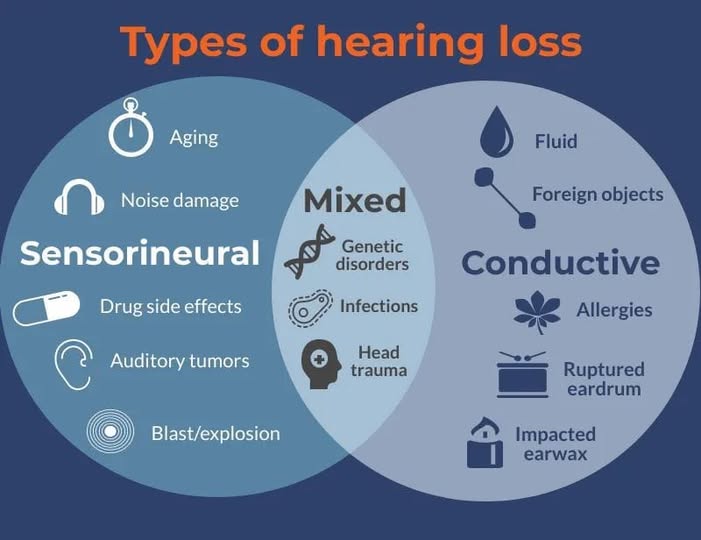
a. Bone Conduction Hearing Aid
This type of hearing aid carries the sound vibrations to the inner ear through the bones of the skull with the aid of the skull itself, rather than via the outer and middle ear.
In this sense, it is the most effective for individuals with conductive hearing loss.
b. Air Conduction Hearing Aid
Air conduction type of hearing aids pick up and deliver the sound into the ear canal through the eardrum and middle ear.
They can be adjusted to a wide range of hearing impairments and come in different forms like behind-the-ear (BTE), in-the-ear (ITE), and receiver-in-canal (RIC).
c. Cochlear Hearing Aid
Cochlear implants are small electronic devices that are implanted surgically into your inner ear cochlea.
They circumvent the damaged hair cells in the cochlea and directly stimulate the auditory nerve, bringing the sense of hearing to subjects with severe to profound hearing loss.
d. Over-the-Ear Hearing Aid
These hearing aids are either worn behind the ear or over the ear and a connecting customized ear mold or tubing is used to deliver sound directly in the ear canal.
They can be worn by people with mild to serious hearing loss and are available with different features to fit individual needs and to be customized.
e. Inner Ear Hearing Aid
Inner ear hearing aids, more commonly referred to as ITC or CIC hearing aids, are individually fit devices that are seated inside the ear canal.
They are discreet and deliver natural sound, though they may own lesser functionality due to their small size.
f. Micro Hearing Aid
Micro hearing aids are extremely tiny and plain enough to be indiscernible when worn, unlike other types of hearing aids.
These devices meet the needs of those with either mild hearing loss or moderate hearing loss without any high-end extra features like noise cancellation and directional microphones.
g. Body-Worn Hearing Aid
Body-worn hearing aids feature a tiny device that is either clipped onto the clothing or put into the pocket, while the earpiece can be either connected wirelessly or through a tube/cable.
This type is convenient for individuals with severe-to-profound hearing loss since it has robust amplification features.
h. Digital Hearing Aid
Digital hearing aids combine digital signal processing and sound amplification to enhance the signal.
They feature more advanced stuff like programmability, sound reduction, echo cancellation, and frequency shifting.
i. Over-the-counter (OTC) Hearing Aids
Basically, OTC hearing aids are FDA-approved devices tailor-made for individuals having such hearing problems as light hearing loss or moderate hearing loss.
j. Bluetooth Hearing Aids
Bluetooth hearing aids transfer wireless data to smartphones, tablets, and other Bluetooth-capable devices, and they let users stream audio directly to their hearing aids.
They provide for augmented communication through voice calls, music, as well as media.
k. Invisible Hearing Aids
Invisible hearing aids, like CIC (completely in-canal) and IIC (invisible-in-canal) devices, are custom-fitted to sit in the ear canal so that they are not seen when worn.
They are great for the discreet and natural sound.
l. Waterproof Hearing Aids
Water-proof hearing aids can stand against moisture, so they can be used by those who like to go in for water activities such as swimming or showering.
m. AI Hearing Aids
Human-AI conversation is designed to analyze and adapt to the situation in the hearing environment and process the sound and speech in real-time, in order to optimize the quality of sound and speech understanding in different situations.
n. Custom Hearing Aids
Custom hearing aids are custom-made by professional audiologists for fitting in the specific shape of a patient’s ear canal or a part of the outer ear.
They ensure the highest comfort level, volume, and sound settings as desired by the particular hearing-impaired person.
Hearing loss is typically classified into five levels:
1️⃣ Mild Hearing Loss (26-40 dB) – Most sounds are audible in quiet environments, but conversations in noisy settings may be difficult to understand.
2️⃣ Moderate Hearing Loss (41-55 dB) – Speech needs to be louder to be understood, and soft or distant sounds may be hard to hear.
3️⃣ Moderately Severe Hearing Loss (56-70 dB) – Daily communication becomes challenging without a hearing aid.
4️⃣ Severe Hearing Loss (71-90 dB) – Only loud speech or strong environmental sounds, like car horns, are detectable. Hearing aids or cochlear implants are usually necessary.
5️⃣ Profound Hearing Loss (91+ dB) – Hearing is nearly nonexistent, and only very loud sounds or vibrations can be perceived. Cochlear implants or sign language may be required for communication.
If you suspect hearing loss, consult a professional audiologist for a hearing test.
🔍 Discover our hearing aid solutions 👉 Contact Us
Pocket (Body-worn type) hearing aids are used for mild to profound hearing loss. As per the hearing loss report, this type of hearing aid is selected according to the gain already set with the specific hearing aid. A few varieties of such gain levels are the mild gain hearing aid, moderate to moderately severe gain hearing aid, severe gain hearing aid, and profound gain hearing aid. The body-worn pocket model hearing aid consists of a cabinet with an amplifier and an outside receiver connected with wire to the cabinet. It is mainly analog-type low-cost hearing aid.
Body-worn hearing aids have a small box that clips to clothes or fits inside a pocket. A lead connects this to the earphone. Some senior citizens find pocket hearing aids easier to use than the smaller types since they are quite large and the controls are easy to operate. Besides, pocket model hearing aids can be worn on the waist belt, trousers pocket, and pocket which is convenient and easy. HomeWellness pocket hearing sound amplifier is rechargeable with type C port. 2 hours of charging can work for about 60 hours. different model and 7-level volume control are available. Usually, older people prefer this type of hearing aid because they feel that it is easier to handle with because they have large controls that are better visible.
However, very few models of this type are now produced. Pocket hearing aids can be very powerful, meaning that they are most suitable for individuals with very severe hearing losses and their relatively large size makes them easy to handle and adjust.
HomeWellness J-101, J-105, and J-107 are worn pocket-size hearing aid, we recommend these hearing aids for the aged or who can’t operate the small size hearing aid.
If it is standing stock, we need 1-3 days to ship after payment.
If it is a customized product, it will take about 10-25 days.
We usually ship by DHL, UPS, FedEx or TNT for small orders .
The delivery time is about 7-15 days; If big order, we can ship by Air or by Sea.
We support one-year quality assurance, if products have quality problems, they can be returned for free repair. For export products that cannot be returned, we support the provision of spare parts at 0.3% of the order.
Yes, we provide OEM and ODM service.
We are professional manufacturer of hearing aids, with a technical custom service team, supporting OEM and ODM. We have our own design team to ensure stable delivery, which can produce renderings within 8 hours and deliver samples within 72 hours. By now, we have etablished a long-term in-depth cooperative relationship with a number of international logistics.
Yes, we provide the sample for you to test and check product quality.